

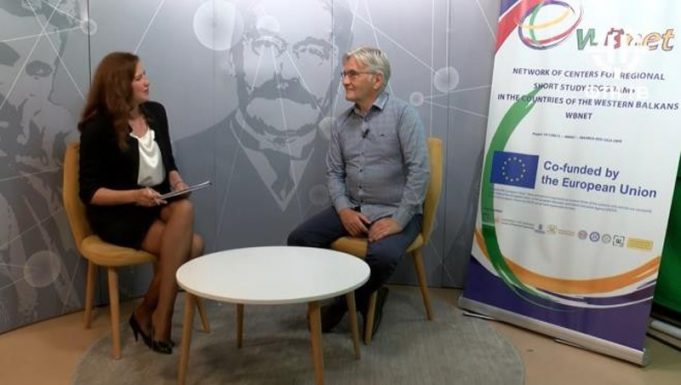
On 11 May 2026, the Faculty of Technical Sciences of the University of Priština in Kosovska Mitrovica (UPKM) hosted an internal quality audit within the Erasmus+ Capacity Building in Higher Education project “Network of Centers for Regional Short Study Programs in the Countries of the Western Balkans (WBNET)”.
The audit was carried out by Prof. Slobodan Bojanić from Universidad Politécnica de Madrid (UPM) and formed part of the project’s quality assurance and monitoring activities aimed at evaluating the implementation and sustainability of newly developed short study programs.
During the visit, the UPKM project team presented the results achieved through the establishment of the Center for Short Study Programs and the implementation of two innovative educational programs: “Applied Information-Communication Technologies” and “Multimedia”. The programs have been developed to provide participants with practical knowledge and competencies in information technologies, programming, digital communications, multimedia production, and digital content creation.
The audit included an evaluation of curricula, teaching methodologies, professional practice arrangements, cooperation with employers, and the institutional framework supporting the implementation of short study programs and micro-credentials. Special attention was devoted to the modern laboratories and equipment established through the WBNET project, which provide participants with access to contemporary digital technologies and practical learning environments.
The reviewer also assessed promotional activities, student enrollment procedures, and cooperation with industry partners involved in professional practice and curriculum development. The first implementation cycle successfully attracted participants to both short study programs, demonstrating the relevance of the developed educational offer and its alignment with labor market needs.
The audit confirmed the successful implementation of project activities at UPKM and highlighted the institution’s contribution to the modernization of higher education through innovative, practice-oriented learning opportunities and lifelong learning initiatives.
The visit further demonstrated the important role of the WBNET project in strengthening cooperation between higher education institutions, industry, and local communities while supporting the development of flexible educational pathways based on short study programs and micro-credentials.
